The Song Remains the Same
On music, memory, and mourning

I am at a concert in honor of my big sister (for whom classic rock was a deep source of inspiration). While I find comfort in mourning her loss through music, at times I am left with a sense of scavenging from a patchwork of memories; feeling like a solo traveler on a perpetual quest for connection. And sitting here, in the darkness of this bass-infused space, I feel an upsurge of sadness at the colliding energies of presence and absence.
This is the final stop in a tribute tour to Led Zeppelin, organized (and performed) by late drummer John Bonham’s son, Jason Bonham (also a seasoned drummer). And if that weren’t motivation enough, we are fortunate to be assembled in a magnificent, Spanish Renaissance-style theatre built in 1927; facing the very same stage where I heard poet Maya Angelou speak nearly 18 years prior.
The band is performing selections from Zeppelin’s double album, Physical Graffiti; which included both new and previously recorded songs. Propped on a circular platform is a glistening drum kit adorned with a large image of John Bonham. While the son is clearly a talented musician in his own right, I am moved by the reverence he displays for his deceased Dad through his sheer dedication to replicating the iconic rhythms. Just as I am devoted to honoring my sister through our shared love of music, story, and simpler times.
I look around at the crowd, many of whom (as evidenced by their giddy enthusiasm) are die-hard fans of a certain age, awed by the exposure to one degree of separation. The son brings an intimacy to the gathering by pausing to impart anecdotes that convey the humanity behind his rock legend father.

Later, he invites us to raise our cell phones in a glowing show of unison. (And I have to say, it’s an unexpected joy to assign the devices a more noble and rudimentary mission). A woman in front of me valiantly holds up her flaming lighter instead of her phone. I smile and think, She’s old school, and feel a wave of melancholy at the sentiment. This is something my sister would have done, partly in defiance of following the masses, and partly in solidarity with those who adhere to a simpler way of being.
The chandeliers, marble, and gold accents exude hints of the building’s original incarnation, constructed in a bygone era of silent films, vaudeville, and the emergence of ‘talkies’ - when men strolled about in dapper suits and tilted fedoras, and women sashayed in flowing dresses and thick stockings. And now, I am but one in a sea of Gen Xers and baby boomers, donning our blue jeans, t-shirts and sandals; sipping from water bottles, beer cans, plastic wine cups.
The glorious old theatre juxtaposed with our casual attire reflects a ‘comfortable in our own skin’ mentality that comes with age and experience. My sister would have fit in perfectly. But what do I know? Maybe she’s right here with us, ALL of us - the current and former versions of US - rocking out to a lyrical confluence of past and present, effortlessly pooled together in this mystical concoction. The music, a metronome of aging and blooming, birthing and dying - of sunrise and moonrise and all things wild.

I’m thinking about physical graffiti as it applies to grief, and the objects and people left behind. I’m thinking about legacies and bloodlines and storylines. I’m thinking about things said and not said, things done and not done. I’m thinking about sweet sparks of nowness and partially-realized moments stunted by fear and distraction.
I’m pondering the ways we might decorate the metaphorical walls of our lives with invisible graffiti. How do we want to be remembered? Will we beautify or disparage, connect or divide?
Is this a concert or an inner uprising?
If I close my eyes, I can transport myself to another time. Can I practice the art of conjuring, plucking notes of nostalgia from forgotten realms? Can I reserve space for longing to shift into story?
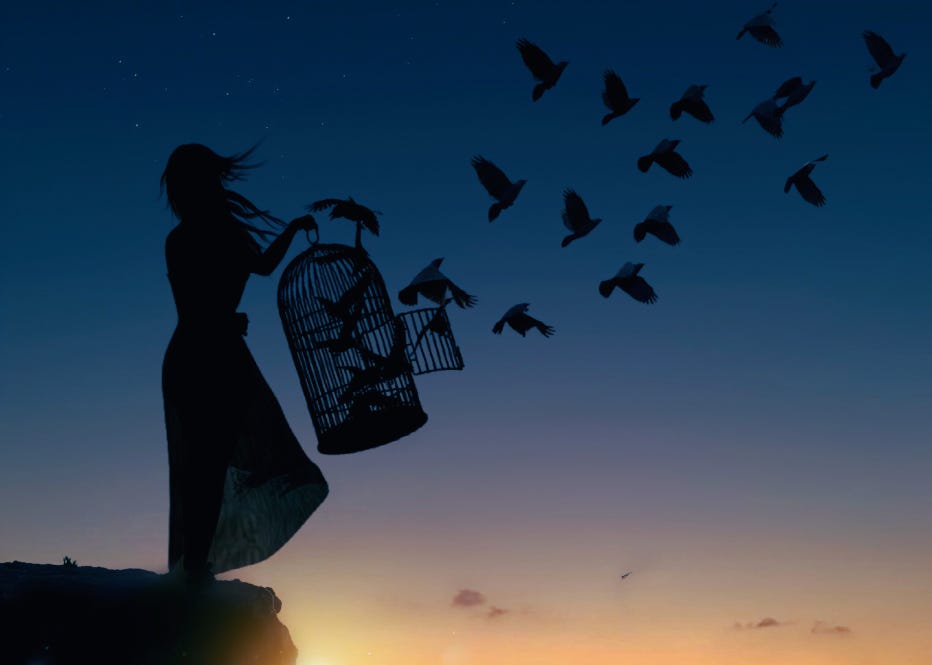
The domed ceiling and ornate fixtures bring a richness of texture to the setting and sound. And I can almost hear Maya Angelou’s velvety voice accompanying us on this musical sojourn. In my mind’s eye, I see an uncaged bird chirping and twirling beneath the opulent arches; its soft wings buoyed by the climactic chorus and rising harmonies.
“There is no greater agony than bearing an untold story inside you.”
Maya Angelou, from I Know Why the Caged Bird Sings
Houses of the Holy reverberates while my heart sways with the felt sense of hanging with my big Sis, back in better days. And now, we are Down by the Seaside, sitting in the sun, listening to tunes, co-dreaming with the makers of melody. Both of us, blissfully unaware that we are compiling a treasure trove of memories that will someday carry me through an unforeseen journey of grief.

“And when great souls die,
after a period peace blooms,
slowly and always irregularly.
Spaces fill with a kind of
soothing electric vibration.
Our senses, restored,
never to be the same, whisper to us.
They existed. They existed.
We can be. Be and be better.
For they existed.”
Maya Angelou, from When Great Trees Fall

We stand for the final ovation. High above us, stories soar like wild birds pronouncing their freedom. And I take solace in knowing that even when lyrics become murky and faded - some things will not change. Light, loyalty, love. The song remains the same. ♥